Thursday, September 10, 2015

From Kilwa Kisiwani to Highland Park


Part 8 of 13 in our journey from Timbuktu to Kalamazoo
(Connecting Landmarks in Michigan and African History)


Highland Park Ford Plant
Highland Park, MI was launched into the spotlight when Henry Ford purchased 160 acres of land just north of Manchester Street between Woodward Avenue and Oakland Street. Construction of the Highland Park Ford Plant (designed by Albert Kahn) was completed in 1909. The small village of Highland Park went from a population of 4,120 in 1910 to around 46,500 in 1920. At Highland Park, Ford would relocate his Piquette Avenue Assembly Plant and implement the first assembly line for the production of automobiles. At its peak it would produce 1000 "Tin Lizzies" a day.
Chrysler headquarters before
demolition

In 1913, Highland Park's Brush-Maxwell automotive factory opened as a division of the United States Motor Car Company. The factory complex shared space with the Chalmers Automotive Company. Chalmers ended production in 1923 and in 1925 the Maxwell Motor Company was reorganized into the Chrysler Corporation. The original Brush-Maxwell plant would grow to a size of 150 acres and become home to Chrysler for the next 70 years.

But just as quickly as the automotive industry arrived, it left Highland Park. Ford Motor Company downsized its operations in the late 1950s and eventually sold the factory in 1973. The Chrysler Motor Company moved its headquarters to Auburn Hills between 1991 and 1993 dislocating a total of 6,000 jobs. Highland Park's population dropped from a peak in 1930 of 52,959 to 11,176 in 2010.

Packard Motor Plant

Fisher Body Plant 21

Ford Piquette Avenue Plant

What remains today is a city struggling to recover from the loss of its auto industry. The city and its surroundings are littered with the history of its once mighty automobile production. In addition to the Ford and Chrysler plants, you can still find other abandon automotive manufacturing monuments. At Detroit's Milwaukee Junction, one can find Henry Ford's first assembly plant and the Fisher Body Plant 21. Not far from Piquette Avenue, you can find the Packard Motor plant. And there are many more abandon sites that provided the parts and raw materials in support of these might assembly plants.
The Mosque of Kilwa

As one looks at the photos of these abandon factories, I can't help but compare them to ruins found on the east coast of Africa. The ruins are remnants of a great trading empire that once supplied goods across the Indian Ocean to India, China, Indonesia, Arabia and Rome. These cities were the melting pots that gave birth to the Swahili culture. Today, when comparing these decaying structures to those found in Highland Park and Detroit, the same emotions are invoked. Just how mighty were these cities? What did they produce? How did they so quickly disappear?


Trade along the east coast of Africa existed as far back at 60 AD. The cities included Kilwa Kisiwani, Songo Mnara, Kizimikazi, Sanje Majoma and Unguja Kuu. The greatest of these cities was Rhapta, whose location today is still debated, but whose trading might lives on in the ancient Roman navigating guide the "Periplus of the Erythraarean Sea" (Periplus of the Red Sea).


The great Muslim explorer Ibn Batutta reached the city of Kilwa in 1331 and wrote,

"We ... traveled by sea to the city of Kulwa [Kilwa in East Africa]...Most of its people are Zunuj, extremely black...The city of Kulwa is amongst the most beautiful of cities and most elegantly built...."
The Mosque of Kilwa

The great Mosque of Kilwa built in the 11th century is probably the most famous piece of architecture that remains from these cities. Built out of coral stones and lime mortar, it contains sixteen domes believed to be the first true domes on the east African coast. The largest dome would retain its title as the largest on the east African coast until the 19th century. Proof of the city's trading might is found in the Mosques' chief decoration of embedded Chinese porcelain. Other buildings on Kilwa include the Husuni Kuba palace built around 1310 and the Geraza (Swahili for 'prison').

Songo Mnara

At Songo Mnara, one can find the remains of five mosques, a palace complex and some thirty-three domestic dwellings constructed of coral stones and wood.

At Unguja Ukuu, oral legend tells of how a local land owner, Mohammed was Joka, could foresee the future and could cast spells making the city invisible. For a period, it was the capital of Zanzibar.
The Chinese explorer
Cheng Ho

These cities were trading with India and the Chinese long before the arrival of the Europeans. Goods exchanged included ivory, tortoise shells, gold, spice, and iron. In 1417, the great Chinese explorer Cheng Ho (or Zheng He) on his sixth of seven expeditions reached East Africa. He is said to have traveled with more than 300 ships and 28,000 men. The largest of his vessels was 444 ft. in length (By comparison, Columbus' Santa Maria was 60 ft. in length). After the death of the Chinese Emperor in 1425, contact with the Chinese ended opening the door to the Europeans.
Indian Ocean Trade Routes

The Portuguese explorer Vasco Da Gama reached east African shores in 1488. Finding little gold, the Portuguese besieged cities like Kilwa and indulged their appetite for slave trade. And with their arrival, began the slow decline and eventual abandonment of most of these trading cities. By 1840 Kilwa was abandon.


Songo Mnara

Kilwa Kisiwani

We know very little of what life was like in these Swahili cities. It wasn't until the 1960s that the search for the City of Rhapta began in earnest. Serious archaeological investigation of Kilwa didn't begin until the 1950s. Much of Kilwa's mysteries remain unexcavated. In 2008, the World Monuments Fund included Kilwa on its Watch List of 100 Most Endangered Sites. It seems amazing that ruins such as these remain unstudied. These are truly lost cities and it's my hope that their mysteries can be solved before they are forever lost to time and the elements of nature.

Monday, July 20, 2015

From Zanzibar to the Shrine of the Black Madonna

Part 7 of 13 in our journey from Timbuktu to Kalamazoo
(Connecting Landmarks in Michigan and African History)

The diverse colors of Africa
As an African-American I've always want to travel to Africa; to somehow re-trace the steps of my ancestors. I've even had the strange experience of being mistaken for a Somalian (until I opened my mouth). As a child, while classmates could call themselves Irish, or German, my roots were tied to an entire continent. But as I grow older, I realize that the countries that make up Africa are as different as the color blue is from red. By calling oneself Black, you are essentially calling yourself a composite of all colors as a place holder for not knowing your actual African lineage.


African-Americans are different than any other immigrant population that arrived in the US: we are a people who were forced to come to America. For African-Americans, assimilation means forgiving a country's past mistreatment and believing in its potential to change. It takes the leap of faith that the principles that this country was founded upon can transcend the problems we face today. That these principles are tools for change and that using them will make things better. And it's this faith that gives the choice to assimilate or separate its religious connotations.

Shrine of the Black Madonna
This debate erupted for Detroit in 1967. On Easter of that year, Rev. Albert Cleage unveiled an 18 foot painting of the Black Madonna and renamed his Central Congregational Church the Shrine of the Black Madonna. His actions launched the Black Christian National Movement, which called for all Black churches to reinterpret Jesus' teachings to suit the social, economic, and political needs of black people. In his own words,

"I use the concept of a nation within a nation to describe the separation that's enforced on black people... The white man has done too good a job. I was separated from the day I was born... You can't ask me if I'm advocating a separation... I just inherited it." [1]

W.E.B. Dubois and the Niagara Movement

W.E.B. Dubois in 1904
Rev. Cleage's actions are part of a century old debate. The two arguments were eloquently argued by W.E.B. Dubois and Marcus Garvey. W.E.B. Dubois was a proponent of demanding equal rights for African-Americans. As a leader of the Niagara Movement, he believed in full civil rights and political representation. A prolific writer, a major theme of Dubois's literary work was the  double consciousness that African-Americans were faced with. In Dubois's words,

"A world which yields him no true self-consciousness, but only lets him see himself through the revelation of the other world. It is a peculiar sensation, this double-consciousness, this sense of always looking at one's self through the eyes of others, of measuring one's soul by the tape of a world that looks on in amused contempt and pity. One ever feels his two-ness,--an American, a Negro; two warring souls, two thoughts, two unreconciled strivings; two warring ideals in one dark body, whose dogged strength alone keeps it from being torn asunder." [2]

Marcus Garvey and the Back-to-Africa Movement

Marcus Garvey in 1924
Marcus Garvey founded The Black Star Line. His organization arranged for the migration of Africa-Americans back to Africa. As part of the Back-to-Africa Movement, it promoted the return of "the African Diaspora to their ancestral lands."

Many whites tried to help African-Americans with the dilemma, helping to fund and recruit the repatriation of Blacks to Africa. The American Colonization Society was founded by white supporters of gradual emancipation and actively worked to re-settle free African-Americans in Africa. Detroit's Reverend William C. Monroe of Second Baptist Church (Detroit's first African-American church) immigrated to Liberia, along with other members of the Society. African-Americans would also migrate to Ghana, Ethiopia, and Sierra Leone.

Detroit politics have always been infused with the question of assimilation or separation. Today's City which is 82.2% Black and its neighboring City of Dearborn which is 89.1% white is still dealing with the legacy of the line politicians drew at the City's Eight Mile border.
 
In Detroit, as in America, the question has always been: Are we African or are we American?

Zanzibar
As polarizing as this issue is among Americans, it seems odd that if we travel a few thousand miles, to a small island that exported many blacks to the US and Middle East as slaves, we will find a people struggling with the same question, but through a different lens. For the people of Zanzibar, the question is: Are we African or Arab?

Figure within Zanzibar
Slave Monument
For over 2,000 years, east coast Africa traded with the Indians, Chinese and Europeans. But with the arrival of the Portuguese, the slave trade began to dominate its economy. The height of east coast slave trade was reached during a period from 1770-1870. Zanzibar became its center sending half its victims to Arabia and Egypt and half to the Portuguese (and eventually the New World). Under the rule of the Sultan of Oman, the number of slaves passing through Zanzibar each year has been estimated at 15,000, though some estimate as high as 45,000. [3]  In the 1870s, up to 2/3rds of the Zanzibari population were slaves.[4]  The British would finally end slave trade on the island in 1873.


Zanzibar Slave Monument
This created a dilemma. As explained by Henry Louis Gates, Jr., during slave times, it was a mark of status to call oneself Arab. To be Swahili (or African), was to be culturally inferior or descendants of slaves. But when the slave trade ended, it became a liability to be Arab, since they were the harsh perpetrators of the slave industry. Therefore, despite the reality that the vast majority of people can trace their descendants to the African mainland, they created a more specific Arab identity. They traced their lineage to Persia calling themselves Shirazi (from the Shiraz in modern Iran). Thus they created a way to avoid the stigma of being African and being associated with the evils of the Arab slave traders.

Stone Town

Stone Town
But despite this racial hierarchy, the entire island is filled with examples of Arab, Indian, European and African assimilation. The small island sits on a boundary and like the point where salt water meets fresh water, something fresh and new was created. Below are Zanzibar's keys influences:

Zenj Bar (Black Empire)
Zanzibar's Kizimkazi Mosque
During the 8th-10th centuries a group of coastal cities made up the Zenj Bar. Under the influence of peoples on mainland Africa, ruins of some of these cities have been unearthed (but left mostly unstudied). Our next chapter will talk more about these cities and their contact with Chinese, Indians, Arabs and Romans. At Kizimkazi, one can find a 12th century mosque still in use, the oldest evidence of an Islamic presence in east Africa.

Palace of the Sultan Barghash
(House of Wonder)
Omani Arabs
Stone construction was introduced to Zanzibar by the Omani. The name "Stone Town" comes from the use of coral stone as the main construction material and gives the town its unique warm reddish color. The oldest building, the Old Fort (Ngome Kongwe,) was built by the Omani Sultan in the 17th century. The Omani would build the City's oldest mosque with its distinctive conical minaret (Malindi Minaret Mosque) in 1831. And in 1896, the Palace of Sultan Barghash (the House of Wonder) was built.
 
Indian style carved door
India
The Indians introduced two key architectural features to Zanzibar. First, as Indian merchants began to buy Omani homes, they added wide verandas protected by carved wooden balustrades. Secondly, they introduced the tradition of carving elaborate entry doors. The doors come in two styles: Indian style with rounded tops (and lotus flowers) and Omani style which are rectangular (with Islamic content).


Anglican Cathedral
 of Christ Church
Britain
At the end of the 19th century, the British arrived. They purposefully built on the site of the biggest slave market in Zanzibar the Gothic Anglican cathedral of Christ Church. Then in 1893, construction of the Romanesque styled Catholic Cathedral of St. Joseph was begun.

Conclusions
The demons of slavery continue to haunt two countries. In both, the descendants of slaves struggle with their identity. Both African-Americans and Zanzibari struggle with regenerating the history of their African heritage.

The Swahili Style
For me, the beauty of Swahili lies in the wonderful assimilation of all its influences. I love the fact that for Americans Swahili is the most recognized African language. It's the language used to celebrate the African-American holiday of Kwanzaa. It's the language my daughter's name is derived from. And though Swahili was spoken by very few of the slaves brought to American, it's the perfect language to represent the joining of African and American traditions. And it gives me hope that the demons of slavery will someday be overcome in both America and Zanzibar by the beauty of Swahili culture.

-----------------------------------------------
[3] Gates, Jr., Louis, Wonders of the African World, pg. 182.
[4] Ibid, pg 187.

Wednesday, May 13, 2015

From Lalibela to Sacred Heart

Part 6 of 13 in our journey from Timbuktu to Kalamazoo
(Connecting Landmarks in Michigan and African History)

Gateway to Freedom (Detroit)
 by Ed Dwight
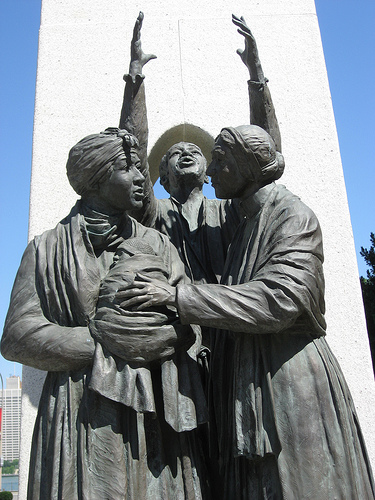
What was is it like as a fugitive slave to stand at the shores of the Detroit River looking across to Canada? I can imagine outstretching an arm and trying to touch freedom. The short distance between Detroit and Windsor made this a natural final stop along the underground railroad. Today, companion memorials stand on each side of the Detroit River commemorating the thousands who earned this freedom.
Freedom Tower (Windsor)
by Ed Dwight

In 1773, a British census counted 93 slaves in Detroit. By the next decade, this number would grow to almost 200. A story in The History of Detroit 1701-1922 by Clearance Monroe, William Stocking and Gordon K. Miller recounts a Negro slave woman and a Frenchman accused of a crime, resulting in the British Commandant being transferred to Fort Niagara. In 1776, Captain Richard Beringer Lernoult was transferred because of his refusal to hang the accused African slave woman.    


The firm of Abbott & Finchly carried on one of the largest trading establishments in the place. One of their employees was a Frenchman named Jean Baptiste Contencineau. A Negro slave belonging to James Abbott was named Ann (or Nancy) Wyley. The Frenchman and the slave formed a plan to rob the storehouse of the firm and then to set fire to it in order to avoid detection…On June 24, 1774 the Frenchman at the request of the woman set fire to the building and carried away from it as the plunder he wanted a small box containing six dollars… of which four dollars were silver and two dollars were paper…

The prisoners were tried before [Judge Philip] Dejean the justice possibly with a jury and certainly with the approbation of [Lt-Governor Henry] Hamilton. They were found guilty and Dejean sentenced them to be hanged. Without unnecessary delay, the day of execution was set but public sentiment had so changed that it was found impossible to get an executioner. Hamilton then agreed to free the woman from the penalty about to be inflicted upon her if she would act as executioner on the Frenchman. Of course she agreed and the Frenchman was accordingly swung off. [1]
    
Lt.-Governor Henry Hamilton
Not exactly a story with a happy ending, but due to public outrage, Judge Dejean and Lt-Governor Hamilton were indicted for this and other abuses of power.

In 1787, the US Congress enacted the Northwest Ordinance making slavery and involuntary servitude illegal in the territories of Michigan, Ohio, Indiana and Wisconsin. British controlled Ontario would follow in 1793. But by no means did this emancipate those already held in slavery.

Judge Augustus Woodward
The Americans would finally take control of Detroit in 1796. And it would be a ruling by Judge Augustus Woodward (for whom Detroit's main street is named after) in 1805 that would give slaves their freedom except for those held by British citizens prior to American control. What this meant was that the slave population would linger in Detroit's records until 1830, when the census recorded 281 free blacks and 32 slaves. At this point, at least for Michigan, slavery would become a southern state issue. The Fugitive Slave Act of 1850 ensured that if a fugitive slave was captured in a free state, they could be legally sent back to their slave master. Only by going to Canada, could a fugitive slave insure their freedom. Canadians refused to extradite fugitive slaves back to the US.
Ste. Anne du Detroit
(current location since 1866)

Christian life began in Detroit when the first building was constructed at Fort Pontchartrain du Détroit. Construction began on Saint Anne's church on July 24, 1701. Today it is the second oldest continuously operating Roman Catholic parish in the US. It seems logical that the church would be advocates for slavery's abolition. But they were not immune to the same racial prejudice that had infected the greater society. African-Americans were allowed to believe, but forced to worship separately.

Second Baptist Church
(circa. 1898)

Second Baptist Church today
(current location since 1852)
In 1836, thirteen freed slaves organized the Second Baptist Church after being mistreated as members of the First Baptist Church. It marks the beginning of the African-American church becoming (as described by the African-American run Michigan Chronicle) the "catalyst for ushering in positive social, economic and spiritual change for Detroiters."[2] Second Baptist would become a leading advocate for African-American civil rights and suffrage. Included among its famous members is Ralph Bunche the first African-American to win the Nobel Peace Prize. Frederick Douglass,  Dr.Martin Luther King, Jr. and Sojourner Truth (who in 1867 made her home Battle Creek, MI) would all gives speeches from its pulpit. Today, Second Baptist is Michigan's oldest African-American congregation and Detroit's seventh oldest church. They would help some 5,000 fugitive slaves escape to freedom in Canada. Occupying its current location since 1852, one can still visit a room constructed under the sanctuary built specifically to hide escaping slaves until they could continue their journey to freedom in Canada.

<><><><><><><><><><><>
</>
<><><><><><><><> </>
Sacred Heart
Roman Catholic Church
(built in 1875)
It wouldn't be until 1938 that Detroit's Roman Catholic leadership recognized the need to establish a Black church.  As Detroit's demographics changed, the parish of Sacred Heart no longer found itself within the heart of a German community, but instead within Hasting Street's Black Bottom. The diocese therefore decide to convert Sacred Heart to African-American.  Worshipping from a school building, the Jim Crow Parish of St. Peter Claver, which Detroit's first African-American Catholic Priest Norman "the Duke" Dukette had help organized in 1911, now had a new home.

Black congregations therefore evolved into serving two purposes. First, they served as advocates for change. Second, and perhaps more importantly, they served as safe havens from the discriminatory practices of the greater society.

Bet Giyorgis
(St. George Church)
Bet Emanuel
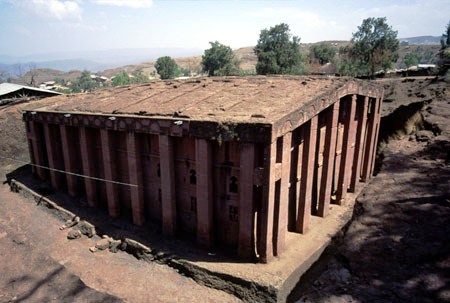
Half way around the world and almost 700 years earlier, King Lalibela, the first Emperor of Ethiopia, is said to have seen Christianity's most holly city, Jerusalem, in a vision. Placed in a three day coma by an attempted murder by his ruling brother, he dreamed that he was ascended to heaven and commanded by God to construct a new Jerusalem. It was 1187 and the Muslims had captured Jerusalem (launching Europe into the Third Crusade). From this vision, he built a new holy city "that would be invisible to invaders and protect the faith and wealth of the Ethiopian Orthodox Church and his empire."[3]
Bet Maryem

Bet Medhane Alem
(Largest monolithic rock-hewn
Church in world)

What he would create would be a network of 13 churches in the heart of Ethiopia's highlands. At an altitude of almost 9,200 feet, each would be carved out of red volcanic rock. Four are completely free-standing structures, attached to their mother rock only at their bases, the remaining either semi-detached or whose facades are the only features that have been 'liberated' from the rock. The rock churches, although connected to one another by maze-like tunnels, are physically separated by a small river which the Ethiopians named the Jordan.  Construction work began and is said to have been carried out with remarkable speed. According to legend, angels joined the laborers by day and at night did double the amount of work which the men had done during the hours of daylight.
<><><><><><><><> </> </> </>
King Lalibela

Lalibela remains a high place of Ethiopian Christianity, a destination for pilgrimages and expressions of devotion. And just as Detroit's network of Black churches, joined by Second Baptist and Sacred Heart, uses its faith to drive its advocacy for change, Lalibela speaks to the amazing accomplishments that profound faith can achieve. Let's hope that the strength and leadership of Detroit's faith community can be used to unify all its members and like King Lalibela create a rejuvenated Detroit.

------------------------------------------------
[3]  Gates, Jr.,  Louis Henry, Wonders of the African World, pg 91.


Monday, May 4, 2015

From Axum to Hart Plaza

Part 5 of 13 in our journey from Timbuktu to Kalamazoo
(connecting landmarks in Michigan and African history)

Antoine de la Mothe Cadillac makes his way along the Detroit River (known to the French as the strait of Lake Erie) searching for a point to land. It's 1701 and he chooses a position where the channel is about one-half-mile wide and his cannon stand "one gunshot across" the river. On this spot he founds Fort Pontchartrain du Détroit.

Fort Pontchartrain in 1701
For the next hundred years, the small fur trading settlement and military garrison would struggle to thrive, withstanding occupation by the French, the British (who take control in 1760 during the French Indian war), Native Americans (who lay siege to the Fort in 1763 during Pontiac's Rebellion) and finally the Americans (through the Jay Treaty of 1796). In fact, in 1805 the entire city burned to the ground except for a river warehouse and a few brick chimneys. In a period of peace between the French and British, the French actually voted to abandon the fort. The order was thankfully never executed. However, Cadillac's dream of displacing Fort Michilimackinac and trading posts to the north as the capitol of fur trade all but died particularly because of its inaccessibility both by land (connections to Toledo were frequently in passable) and water (lake Erie was considered by many more dangerous than the Atlantic).

Detroit riverfront in 1820
But the fortunes of the settlement suddenly changed because of two events in the early 1800s. First, in 1818 the first steamboats began to regularly appear on Lake Erie. Now scheduled trips from Buffalo to Detroit could be achieved (something that sailing vessels driven by the wind had never been able to accomplish). Second, the Erie Canal was completed in 1825 by the state of New York. The canal linked the Hudson River to Lake Erie and the port towns of the Great Lakes. The canal, along with the Great Lakes steamers, offered an inexpensive water route by which to move settlers and their possessions westward and the fruits of their labor eastward to market.
Detroit Fire of 1805
Woodward's Detroit Plan
1807
Shortly after the fire of 1805, Woodward laid-out a new plan for the City, modeled after Pierre Charles L'Enfant's plan for Washington DC. The land was sub-divided and in 1818 first offered either for sale or as compensation to those who lost property in the fire. Detroit's population swelled and its economy transformed itself from fur-trade, to agriculture and to finally manufacturing. By the late 1800s, major manufacturing facilities occupied the Detroit riverfront. In 1870 came Parke-Davis, in the 1890s came the Frederick Stearns Company, in 1888 came the Globe Tobacco manufacturing facility and in 1860 came the Detroit Dry Dock Engine Works (where Henry Ford would work as a young engineer). 
The Detroit Riverfront circa 1950
Pre-Civic Center Development


By the early 1900s, Henry Ford's automobile industry became king. It drew tens of thousands of new residents, particularly workers from the south, making Detroit the US's fourth largest city. At the same time, tens of thousands of European immigrants located in the city. But the requirement that industry be centrally located along the Detroit riverfront was no longer necessary. Railroad, truck and air transportation, if not equaled, outpaced water travel. By the end of World War II, the old riverfront industries begin to abandon the Detroit riverfront.
 
Hart Plaza
In 1947, Eliel Saarinen and his son Eero, developed a master plan for a new Detroit civic center which incorporated restoring public access to the riverfront. Construction began in 1950 with the Veterans Memorial Building (Today's Ford/UAW Building). The Saarinens' original vision for the waterfront was "as a predominantly green sweep of lawn and naturalistic tree clusters gently terracing to the river." The actual hard surfaced 14 acre plaza deviates considerably from this vision. 


Isamu Noguchi's Pylon
But despite these changes, in 1975, on more or less the site at which Cadillac landed, Philip A. Hart Plaza opened. Named for the late U.S. Senator Philip Hart, it marks the intersection of the southernmost terminus of Detroit's main north-south boulevard, Woodward Avenue, and the Detroit river front. Although Isamu Noguchi's Horace Dodge and Son Memorial Fountain is the center piece of the plaza, a second Noguchi piece known as the Pylon stands at the intersection. Set on a low rectangular plinth, the obelisks rises 120 feet in joined polished steel sections, subtly making a quarter turn as it reaches it full height. Its bright and reflective surface mimics the cylindrical towers of the Renaissance Center (now GM World Headquarters) that form the Pylon's backdrop.  


A stelae field in Axum
The tradition of marking places of significant importance with obelisks can be traced to many cultures. One of the oldest traditions can be found in Axum, Ethiopia. Here you will find remnants of what Ethiopians call "hawilt/hawilti" or stele. It is here you will find what is believed to be an ancient burial ground for the royal class of the Kingdom of Aksum, where tombs are marked by a field of more than 120 stone carved stelae dating back to 300-500 AD. Each stelae are carved from a single piece of granite and stand as high as 82 feet (the tallest stelae of 108 feet appears to have fallen shortly after it was erected).
The rounded peak


False door at the base
But what is most interesting about these stelae is how they are carved. For like the Noguchi Pylon which dances in the horizon with its neighboring modern skyscraper, these Aksumite stelae are themselves meant to represent ancient skyscrapers up to thirteen stories in height. Although actual Aksumite buildings probably never exceeded a maximum of three stories, they are accurate representations of how taller structures would have been built. The stellae have representative stone doors carved at their feet simulating wooden ones, some even incised with locks. Further up the monoliths, false four-holed windows have been hewn into the rock. Timber, used widely for structural support, is recalled by the false square beam-ends that project as if serving a functional purpose through the stelae "walls." The stelae terminate in rounded peaks marked with fixing holes that once held nails, possibly intended to fasten symbolic icons.

So if you find yourself gazing up at the Pylon in Hart Plaza while enjoying one of its many festivals and/or celebrations, remind yourself of the ancient Ethiopian tradition of building stone carve obelisks known as stele that represent possibly humankind's first attempt to build skyscrapers.