Showing posts with label Ethiopia. Show all posts

Wednesday, May 13, 2015

From Lalibela to Sacred Heart

Part 6 of 13 in our journey from Timbuktu to Kalamazoo
(Connecting Landmarks in Michigan and African History)

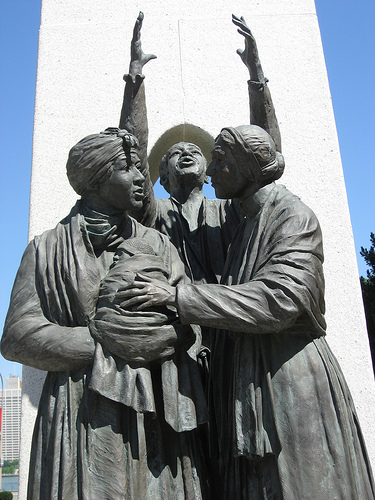
Gateway to Freedom (Detroit)
 by Ed Dwight
What was is it like as a fugitive slave to stand at the shores of the Detroit River looking across to Canada? I can imagine outstretching an arm and trying to touch freedom. The short distance between Detroit and Windsor made this a natural final stop along the underground railroad. Today, companion memorials stand on each side of the Detroit River commemorating the thousands who earned this freedom.
Freedom Tower (Windsor)
by Ed Dwight

In 1773, a British census counted 93 slaves in Detroit. By the next decade, this number would grow to almost 200. A story in The History of Detroit 1701-1922 by Clearance Monroe, William Stocking and Gordon K. Miller recounts a Negro slave woman and a Frenchman accused of a crime, resulting in the British Commandant being transferred to Fort Niagara. In 1776, Captain Richard Beringer Lernoult was transferred because of his refusal to hang the accused African slave woman.    


The firm of Abbott & Finchly carried on one of the largest trading establishments in the place. One of their employees was a Frenchman named Jean Baptiste Contencineau. A Negro slave belonging to James Abbott was named Ann (or Nancy) Wyley. The Frenchman and the slave formed a plan to rob the storehouse of the firm and then to set fire to it in order to avoid detection…On June 24, 1774 the Frenchman at the request of the woman set fire to the building and carried away from it as the plunder he wanted a small box containing six dollars… of which four dollars were silver and two dollars were paper…

The prisoners were tried before [Judge Philip] Dejean the justice possibly with a jury and certainly with the approbation of [Lt-Governor Henry] Hamilton. They were found guilty and Dejean sentenced them to be hanged. Without unnecessary delay, the day of execution was set but public sentiment had so changed that it was found impossible to get an executioner. Hamilton then agreed to free the woman from the penalty about to be inflicted upon her if she would act as executioner on the Frenchman. Of course she agreed and the Frenchman was accordingly swung off. [1]
    
Lt.-Governor Henry Hamilton
Not exactly a story with a happy ending, but due to public outrage, Judge Dejean and Lt-Governor Hamilton were indicted for this and other abuses of power.

In 1787, the US Congress enacted the Northwest Ordinance making slavery and involuntary servitude illegal in the territories of Michigan, Ohio, Indiana and Wisconsin. British controlled Ontario would follow in 1793. But by no means did this emancipate those already held in slavery.

Judge Augustus Woodward
The Americans would finally take control of Detroit in 1796. And it would be a ruling by Judge Augustus Woodward (for whom Detroit's main street is named after) in 1805 that would give slaves their freedom except for those held by British citizens prior to American control. What this meant was that the slave population would linger in Detroit's records until 1830, when the census recorded 281 free blacks and 32 slaves. At this point, at least for Michigan, slavery would become a southern state issue. The Fugitive Slave Act of 1850 ensured that if a fugitive slave was captured in a free state, they could be legally sent back to their slave master. Only by going to Canada, could a fugitive slave insure their freedom. Canadians refused to extradite fugitive slaves back to the US.
Ste. Anne du Detroit
(current location since 1866)

Christian life began in Detroit when the first building was constructed at Fort Pontchartrain du Détroit. Construction began on Saint Anne's church on July 24, 1701. Today it is the second oldest continuously operating Roman Catholic parish in the US. It seems logical that the church would be advocates for slavery's abolition. But they were not immune to the same racial prejudice that had infected the greater society. African-Americans were allowed to believe, but forced to worship separately.

Second Baptist Church
(circa. 1898)

Second Baptist Church today
(current location since 1852)
In 1836, thirteen freed slaves organized the Second Baptist Church after being mistreated as members of the First Baptist Church. It marks the beginning of the African-American church becoming (as described by the African-American run Michigan Chronicle) the "catalyst for ushering in positive social, economic and spiritual change for Detroiters."[2] Second Baptist would become a leading advocate for African-American civil rights and suffrage. Included among its famous members is Ralph Bunche the first African-American to win the Nobel Peace Prize. Frederick Douglass,  Dr.Martin Luther King, Jr. and Sojourner Truth (who in 1867 made her home Battle Creek, MI) would all gives speeches from its pulpit. Today, Second Baptist is Michigan's oldest African-American congregation and Detroit's seventh oldest church. They would help some 5,000 fugitive slaves escape to freedom in Canada. Occupying its current location since 1852, one can still visit a room constructed under the sanctuary built specifically to hide escaping slaves until they could continue their journey to freedom in Canada.

<><><><><><><><><><><>
</>
<><><><><><><><> </>
Sacred Heart
Roman Catholic Church
(built in 1875)
It wouldn't be until 1938 that Detroit's Roman Catholic leadership recognized the need to establish a Black church.  As Detroit's demographics changed, the parish of Sacred Heart no longer found itself within the heart of a German community, but instead within Hasting Street's Black Bottom. The diocese therefore decide to convert Sacred Heart to African-American.  Worshipping from a school building, the Jim Crow Parish of St. Peter Claver, which Detroit's first African-American Catholic Priest Norman "the Duke" Dukette had help organized in 1911, now had a new home.

Black congregations therefore evolved into serving two purposes. First, they served as advocates for change. Second, and perhaps more importantly, they served as safe havens from the discriminatory practices of the greater society.

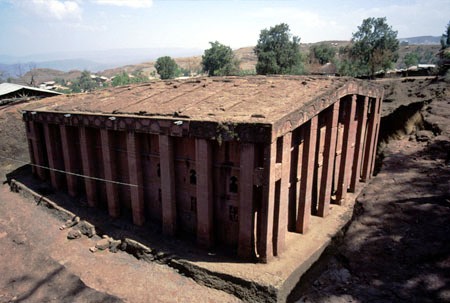
Bet Giyorgis
(St. George Church)
Bet Emanuel
Half way around the world and almost 700 years earlier, King Lalibela, the first Emperor of Ethiopia, is said to have seen Christianity's most holly city, Jerusalem, in a vision. Placed in a three day coma by an attempted murder by his ruling brother, he dreamed that he was ascended to heaven and commanded by God to construct a new Jerusalem. It was 1187 and the Muslims had captured Jerusalem (launching Europe into the Third Crusade). From this vision, he built a new holy city "that would be invisible to invaders and protect the faith and wealth of the Ethiopian Orthodox Church and his empire."[3]
Bet Maryem

Bet Medhane Alem
(Largest monolithic rock-hewn
Church in world)

What he would create would be a network of 13 churches in the heart of Ethiopia's highlands. At an altitude of almost 9,200 feet, each would be carved out of red volcanic rock. Four are completely free-standing structures, attached to their mother rock only at their bases, the remaining either semi-detached or whose facades are the only features that have been 'liberated' from the rock. The rock churches, although connected to one another by maze-like tunnels, are physically separated by a small river which the Ethiopians named the Jordan.  Construction work began and is said to have been carried out with remarkable speed. According to legend, angels joined the laborers by day and at night did double the amount of work which the men had done during the hours of daylight.
<><><><><><><><> </> </> </>
King Lalibela

Lalibela remains a high place of Ethiopian Christianity, a destination for pilgrimages and expressions of devotion. And just as Detroit's network of Black churches, joined by Second Baptist and Sacred Heart, uses its faith to drive its advocacy for change, Lalibela speaks to the amazing accomplishments that profound faith can achieve. Let's hope that the strength and leadership of Detroit's faith community can be used to unify all its members and like King Lalibela create a rejuvenated Detroit.

------------------------------------------------
[3]  Gates, Jr.,  Louis Henry, Wonders of the African World, pg 91.


Monday, May 4, 2015

From Axum to Hart Plaza

Part 5 of 13 in our journey from Timbuktu to Kalamazoo
(connecting landmarks in Michigan and African history)

Antoine de la Mothe Cadillac makes his way along the Detroit River (known to the French as the strait of Lake Erie) searching for a point to land. It's 1701 and he chooses a position where the channel is about one-half-mile wide and his cannon stand "one gunshot across" the river. On this spot he founds Fort Pontchartrain du Détroit.

Fort Pontchartrain in 1701
For the next hundred years, the small fur trading settlement and military garrison would struggle to thrive, withstanding occupation by the French, the British (who take control in 1760 during the French Indian war), Native Americans (who lay siege to the Fort in 1763 during Pontiac's Rebellion) and finally the Americans (through the Jay Treaty of 1796). In fact, in 1805 the entire city burned to the ground except for a river warehouse and a few brick chimneys. In a period of peace between the French and British, the French actually voted to abandon the fort. The order was thankfully never executed. However, Cadillac's dream of displacing Fort Michilimackinac and trading posts to the north as the capitol of fur trade all but died particularly because of its inaccessibility both by land (connections to Toledo were frequently in passable) and water (lake Erie was considered by many more dangerous than the Atlantic).

Detroit riverfront in 1820
But the fortunes of the settlement suddenly changed because of two events in the early 1800s. First, in 1818 the first steamboats began to regularly appear on Lake Erie. Now scheduled trips from Buffalo to Detroit could be achieved (something that sailing vessels driven by the wind had never been able to accomplish). Second, the Erie Canal was completed in 1825 by the state of New York. The canal linked the Hudson River to Lake Erie and the port towns of the Great Lakes. The canal, along with the Great Lakes steamers, offered an inexpensive water route by which to move settlers and their possessions westward and the fruits of their labor eastward to market.
Detroit Fire of 1805
Woodward's Detroit Plan
1807
Shortly after the fire of 1805, Woodward laid-out a new plan for the City, modeled after Pierre Charles L'Enfant's plan for Washington DC. The land was sub-divided and in 1818 first offered either for sale or as compensation to those who lost property in the fire. Detroit's population swelled and its economy transformed itself from fur-trade, to agriculture and to finally manufacturing. By the late 1800s, major manufacturing facilities occupied the Detroit riverfront. In 1870 came Parke-Davis, in the 1890s came the Frederick Stearns Company, in 1888 came the Globe Tobacco manufacturing facility and in 1860 came the Detroit Dry Dock Engine Works (where Henry Ford would work as a young engineer). 
The Detroit Riverfront circa 1950
Pre-Civic Center Development


By the early 1900s, Henry Ford's automobile industry became king. It drew tens of thousands of new residents, particularly workers from the south, making Detroit the US's fourth largest city. At the same time, tens of thousands of European immigrants located in the city. But the requirement that industry be centrally located along the Detroit riverfront was no longer necessary. Railroad, truck and air transportation, if not equaled, outpaced water travel. By the end of World War II, the old riverfront industries begin to abandon the Detroit riverfront.
 
Hart Plaza
In 1947, Eliel Saarinen and his son Eero, developed a master plan for a new Detroit civic center which incorporated restoring public access to the riverfront. Construction began in 1950 with the Veterans Memorial Building (Today's Ford/UAW Building). The Saarinens' original vision for the waterfront was "as a predominantly green sweep of lawn and naturalistic tree clusters gently terracing to the river." The actual hard surfaced 14 acre plaza deviates considerably from this vision. 


Isamu Noguchi's Pylon
But despite these changes, in 1975, on more or less the site at which Cadillac landed, Philip A. Hart Plaza opened. Named for the late U.S. Senator Philip Hart, it marks the intersection of the southernmost terminus of Detroit's main north-south boulevard, Woodward Avenue, and the Detroit river front. Although Isamu Noguchi's Horace Dodge and Son Memorial Fountain is the center piece of the plaza, a second Noguchi piece known as the Pylon stands at the intersection. Set on a low rectangular plinth, the obelisks rises 120 feet in joined polished steel sections, subtly making a quarter turn as it reaches it full height. Its bright and reflective surface mimics the cylindrical towers of the Renaissance Center (now GM World Headquarters) that form the Pylon's backdrop.  


A stelae field in Axum
The tradition of marking places of significant importance with obelisks can be traced to many cultures. One of the oldest traditions can be found in Axum, Ethiopia. Here you will find remnants of what Ethiopians call "hawilt/hawilti" or stele. It is here you will find what is believed to be an ancient burial ground for the royal class of the Kingdom of Aksum, where tombs are marked by a field of more than 120 stone carved stelae dating back to 300-500 AD. Each stelae are carved from a single piece of granite and stand as high as 82 feet (the tallest stelae of 108 feet appears to have fallen shortly after it was erected).
The rounded peak


False door at the base
But what is most interesting about these stelae is how they are carved. For like the Noguchi Pylon which dances in the horizon with its neighboring modern skyscraper, these Aksumite stelae are themselves meant to represent ancient skyscrapers up to thirteen stories in height. Although actual Aksumite buildings probably never exceeded a maximum of three stories, they are accurate representations of how taller structures would have been built. The stellae have representative stone doors carved at their feet simulating wooden ones, some even incised with locks. Further up the monoliths, false four-holed windows have been hewn into the rock. Timber, used widely for structural support, is recalled by the false square beam-ends that project as if serving a functional purpose through the stelae "walls." The stelae terminate in rounded peaks marked with fixing holes that once held nails, possibly intended to fasten symbolic icons.

So if you find yourself gazing up at the Pylon in Hart Plaza while enjoying one of its many festivals and/or celebrations, remind yourself of the ancient Ethiopian tradition of building stone carve obelisks known as stele that represent possibly humankind's first attempt to build skyscrapers.

Friday, March 6, 2015

The Queen of Sheba and Prince Hall


Part 4 of 13 in our journey from Timbuktu to Kalamazoo
(connecting landmarks in Michigan and African history)

Metropolitan Detroit
Prince Hall Masonic Temple
You've probably driven by it many times. A non-descript building that seems to blend in with its aging neighbors at the corner of Gratiot and McDougal Avenues. But on its front a sign reads, "Metropolitan Detroit Prince Hall Masonic Temple". And it's this small sign that signifies the building's connection with both African-American and African history.

Prince Hall
To explain the story of Prince Hall, one must go back to 1775, when a group of fourteen free-by-birth African-Americans were made Masons by an Irish Military Lodge. Now Mason in this context is meant to refer to Freemasons and in 1784, the Grand Lodge of England chartered African Lodge No. 459 in Boston with Prince Hall as its first Worshipful Master.

Freemasons opened lodges throughout the US, reaching Michigan in 1864.  In 1873, Michigan Prince Hall masons sought recognition from their white counter parts, the Grand Lodge of Michigan. Their request would go unanswered.  It would take almost a half a century for  Prince Hall masons to receive this recognition.  Even today, only 41 out of 51 State Grand Lodges formally recognize them.


In reality, there is very little difference between the two types of Freemasons.  And by no means are Prince Hall lodges exclusively African-American.  Both use the imagery of stone mason tools, as used to construct King Solomon's Temple, to convey moral and ethical lessons on "Brotherly Love, Relief, and Truth." To both, King Solomon's Temple is the "most stable and the most magnificent structure that ever existed." All masonic temples are designed with features that can be directly traced to King Solomon's Temple.

Model of King Solomon's Temple
King Solomon would complete construction of his Jerusalem Temple around 950 BCE. Its remains are believed to be located beneath what is today the “Dome of the Rock” where Muslims believe the prophet Muhammad rose to heaven.  It was within this original Temple that the Ark of the Covenant was stored.  The ark is said to contain the stone tablets engraved by God with the ten commandments.
 
The Queen of Sheba travelling
to Jerusalem
One of the best known stories of the Hebrew Bible as well as the Qur'an and Ethiopia's Kebra Negast is that of Queen Sheba's visit to King Solomon. Most believe she was a ruler of the kingdom of Seba that included parts of today's Eritrea, Somalia, Ethiopia and Yemen. She is said to have been drawn to the King because of the fame of his wisdom and wealth.

Our Lady Mary of Zion
Home of the Ark of the Covenant
It is the Ethiopian account that ends with King Solomon and the Queen of Sheba having a son, Menelik I. He would return to Ethiopia as the first king of Aksum.  Menelik I's rein would begin the world's longest continually ruling monarch. Lasting 2900+ years, finally ending in 1974.  He and the Queen of Sheba are believed to have brought home to Ethiopia the Ark of the Covenant, which to this day is said to remain in Axum's Church of Our Lady Mary of Zion. It remains closed to public view and guarded by a single priest.
Dongar Palace

The Queen of Sheba built a palace in 1000 BCE.  Excavated in 1952, the remains of this palace, which is believed to have also held the Ark of the Covenant, lies just outside of Axum at Dongar.  And like Detroit's Prince Hall Masonic Temple, blends into its surrounding, giving little clues of its historical and religious significance. It sits waiting for someone to revitalize its forgotten regality.

  So the next time you pass by 3100 Gratiot Avenue, give yourself a moment to glance at the Prince Hall Masonic Temple and to recognize the significance of its African-American history and its connection to the Queen of Sheba's palace in Axum, Ethiopia.